
For years, I hosted meditation retreats. I’ve been the man ringing the singing bowl at sunrise, and I’ve also been the man signing the venue contracts, planning the excursions, and doing the math on a napkin at midnight. I’ve watched people arrive as strangers and leave crying in each other’s arms. And I’ve sat in other people’s retreats and watched half the schedule turn into a sales pitch.
Then 2020 closed the doors on in-person gatherings — ours included — and I rebuilt my work so the healing could continue without depending on a room. These days my sessions are recorded: meditations you can play at 2am, sound-healing you can lie down inside of whenever your body asks for it.
But people still write to me about retreats. Should I go? Is it worth $3,000? How do I know a good one from a trap?
So here it is — everything I’d tell a friend before they book, from someone who stood on the other side of the circle. And let me say this first, plainly: retreats can be extraordinary. Some of the most sacred rooms I’ve ever stood in were retreat rooms. This guide isn’t here to talk you out of going. It’s here to make sure that if you go, you choose well.
What Actually Happens at a Meditation Retreat
A good retreat has a rhythm: early mornings, sitting practice, meals taken slowly, teaching blocks, movement, time in nature, and circles where people speak honestly — some for the first time in years.
Here’s the part the brochures don’t tell you. Day one feels like vacation — new faces, beautiful setting, a little nervous excitement. Then day two arrives, and with it, the wall. Restlessness. Irritability. A sudden, urgent list of reasons you should leave early. Why did I pay for this?
That wall is not a sign the retreat is failing. That wall is the work. Your nervous system, stripped of its usual noise and busyness, finally starts to downshift — and everything it’s been holding comes up on the way down. The people who stay through day two are the ones crying grateful tears on day three.
So if a retreat promises bliss from the first hour to the last, be careful. They’re selling you the weather, not the climb.
What a Retreat Really Costs — a Host Opens the Ledger
Nobody publishes this, so I will.
Our retreats ran about $3,000 per person, all-inclusive. Here’s roughly where every one of those dollars went:
- About $1,000 went to the venue — lodging and meals. Spaces that can hold a group in comfort and beauty are not cheap, and food is not the place to cut corners when people are doing deep inner work.
- About $700 went to experiences. We refused to run the kind of retreat where you fly across the country to sit in one room for three days and talk about your feelings. We took people out — into the land, into red-rock country, into experiences they still talk about years later. That’s a real cost, and it’s worth every dollar.
- The remaining thousand or so was split between two facilitators. About $500 each. Now divide that by three days that run twelve to fourteen hours — before you count the months of preparation. You’re looking at something close to minimum wage.
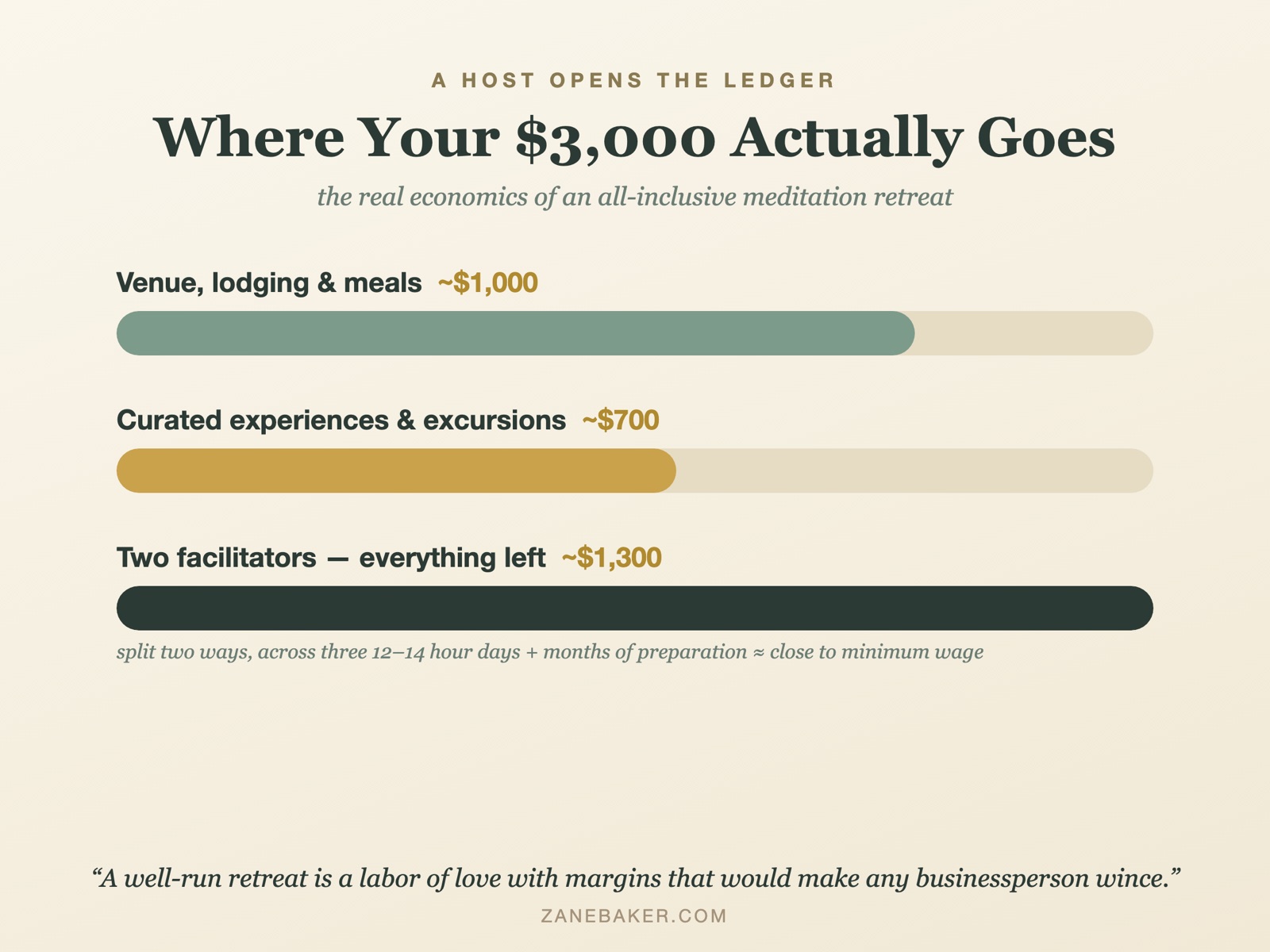
I’m telling you this for two reasons. First, so you know that a $3,000 sticker price does not mean someone is getting rich off you. Run well, a retreat is a labor of love with margins that would make any businessperson wince.
And second — so you can judge what your $3,000 is buying. Ask any host where the money goes. The honest ones will answer without flinching, because the honest ones have nothing to hide. If the price is high and you can see the money — a beautiful venue, good food, small group, real experiences, experienced facilitators — that’s a fair exchange. If the price is high and you’re getting a bare conference room, boxed lunches, and forty other attendees? The money is going somewhere, and it isn’t going into your experience.
A Retreat Is Not a Luxury Wellness Resort (Know Which One You’re Buying)
One distinction that saves people a lot of confusion: the $3,000–$5,000 all-inclusive packages at destination spas — Sedona is famous for them, and versions exist everywhere from mountain resorts to the Las Vegas strip — are not what we’re talking about here. Those are beautiful vacations with spa menus, activity calendars, and excellent sheets.
A facilitated retreat is something different: a container, held by a teacher, with a group and an arc — a beginning, a descent, and a return. That’s the kind this whole article is about — intentional, transformation-focused retreats: meditation, inner-child healing, yoga, and their close cousins. Rooms with a purpose, not just a schedule.
And there’s a real reason those rooms work the way they do. What psychology and neuroplasticity research suggests is that stepping into a genuinely new environment for an immersive experience helps the brain loosen its old patterns — the familiar cues that keep your habits running on rails simply aren’t there. That’s why the transformation people take home from an immersive retreat tends to run deeper and last longer than an insight gathered at your own kitchen table, in the same chair where all the old thoughts live. It’s the honest case for retreats — and it’s exactly why intent matters so much when you’re choosing one.
One rejuvenates the body. The other reorganizes the inner life. Neither is wrong. Just know which one you’re paying for, because they cost about the same and deliver very different things.
How to Choose the Right Retreat for You
Start with your nervous system, not the brochure.
In my work I teach three simple moves — Recalm the body, Reframe the story, Reclaim your power — and the first step is always the body. So ask your body first: how depleted am I, really? If you’re running on fumes, a ten-day silent immersion is not a gift; it’s a shock. Choose gentler: shorter, smaller, more rest built into the schedule. There’s no medal for choosing the most intense option. The right container for where you are will take you deeper than the hardest one you can endure.
Then look at three things:
Group size. We kept ours small on purpose. Past twenty or so people, you’re not at a retreat anymore — you’re at an event. Intimacy is where the work happens.
The facilitator. Has this person walked the road they’re guiding you down — or just certified in it? Ask for a phone call before you book. Fifteen minutes will tell you almost everything. And if a facilitator can’t spare fifteen minutes for someone about to hand them $3,000, that silence is your answer.
Length. For your first retreat, two to three days is plenty. You can go longer once you know how your system responds.
Ten Questions to Ask Before You Book
- What exactly is included in the price — and what costs extra once I’m there?
- Where does my money go? (Watch how they react to this one.)
- How many participants, and how many facilitators?
- What is the facilitator’s training and experience — and can I speak with them before booking?
- What does a typical day look like? Is rest built in, or is every hour programmed?
- Will anything be offered for sale during the retreat? (Get the answer in writing.)
- What’s the refund or transfer policy if life happens?
- How is food handled, and can you accommodate my needs?
- If someone becomes emotionally overwhelmed, what’s your protocol?
- What support do you offer after the retreat ends?
An honest host will love that you asked. Evasion on any of these — especially numbers two and six — tells you everything.
Red Flags I Learned From the Host’s Side
I’ve been in this industry long enough to know its tricks from the inside. Here’s what to watch for.
Start by learning to name the animal you’re buying, because the funnel-builders rarely call their events retreats. Read the sales page closely and you’ll find the real words — mastermind, conference, seminar, summit — dressed head to toe in our language: transformation, breakthrough, sacred container. Understand what those words actually mean. A mastermind is a business-networking room with an upsell architecture built into the floor plan. That’s not evil — plenty of people get real value from those rooms — but it’s a different purchase with different physics. You’re buying proximity and connections, not a healing container. The trouble starts when you pay for one thing wearing the other’s clothes. So when the header says mastermind and the copy says healing, believe the header. Most of what follows lives in that world.
The free event that’s actually a sales funnel
You’re invited to a free three-day gathering. Wonderful! Except the entire three days is engineered toward one moment: the offer. The teaching is real enough to build trust, and the trust is spent on the pitch. This is the seminar world’s signature opening move. Free is fine — I give plenty away free — but notice whether the event serves you or softens you.
The retreat that’s secretly a funnel
This one stings more, because you already paid. Three thousand dollars in — and days two and three quietly become a pitch for the $10,000 mastermind. The language is always the same: accountability, the room you’re in, investing in yourself at the next level. You bought a retreat and got a seminar in a shawl. You came to heal and left holding a payment plan.
The coaching spiral
Some people collect coaching programs the way struggling students collect degrees — one more certification, one more mastermind, surely this one unlocks the life. Hear me on this: if you keep investing with the same teacher and your life isn’t actually moving, stop and ask the hard question. Are you the client — or are you the product? Real transformation shows up as changed days, not upgraded packages.
The big-stage transformation events
I’ll be fair here, because these are beautiful in their own way — masterfully produced, genuinely moving, peak experiences engineered like a great concert. But understand what your body goes through: days of high emotional arousal on little sleep produces altered states — the staff at these events even have joking names for the crash that follows. And understand the business: the event exists, in large part, to enroll you in a five-figure coaching program — with a certified coach, not the famous name on the ticket. If you go, go awake. Enjoy the fire. Read the contract in the morning, with your own nervous system back online.
My own compass, for contrast
I charge $111 for a private session — and the number is deliberate. People have told me, repeatedly and kindly, that I should charge ten times that, because when you tell someone the truth they need and their life changes, that’s worth its weight in gold. Maybe so. But scarcity pricing is the guru move: raise the gate until the room feels exclusive, then sell the exclusivity. I price one honest hour so that a person in crisis never has to choose between rent and truth. The value was never the number — the number is the door, and I hold it open on purpose. Because I’d rather tell you what you need to hear in one honest hour, even if it means you never need me again. A guide’s job is to make himself unnecessary. A guru’s job is to make himself indispensable. Choose guides.
Who Shouldn’t Book a Retreat (Yet)
A retreat is a powerful container, and powerful isn’t always what’s needed first.
If you’re in acute crisis, a retreat is not treatment — the intensity that cracks people open beautifully can overwhelm a system already at its edge. Gentler formats and professional support come first; the retreat will still be there.
If you’re running from your life rather than toward yourself, the retreat will feel wonderful and change nothing — because you packed the problem in your suitcase.
If the price would genuinely strain you, wait. Financial stress in the back of the mind steals the very surrender you’re paying for.
And one more, about expectations rather than readiness. If what you need right now is rest and pampering, book the resort — that is literally what it’s for, and it’s a beautiful choice. But if you book a transformation retreat — meditation, yoga, relationship work, even intimacy-focused retreats — understand what you’re signing up for: you will touch parts of yourself you don’t usually access. That’s not a side effect; that’s the product. If you walk in expecting a vacation, someone misled you — and you deserve to know that before you pay, not on day two.
The Integration Gap: Coming Home Is the Real Retreat
Here’s the section I wish every guide included, because no one prepares you for it.
Somewhere between three and ten days after you come home, there’s a good chance you’ll crash. The glow fades, the old environment reasserts itself, and a strange grief moves in — did any of it even matter? This is so common it should be printed on the booking page. It’s not failure. It’s physics: you opened wide in a supported container, and now you’re back in rooms that haven’t changed.
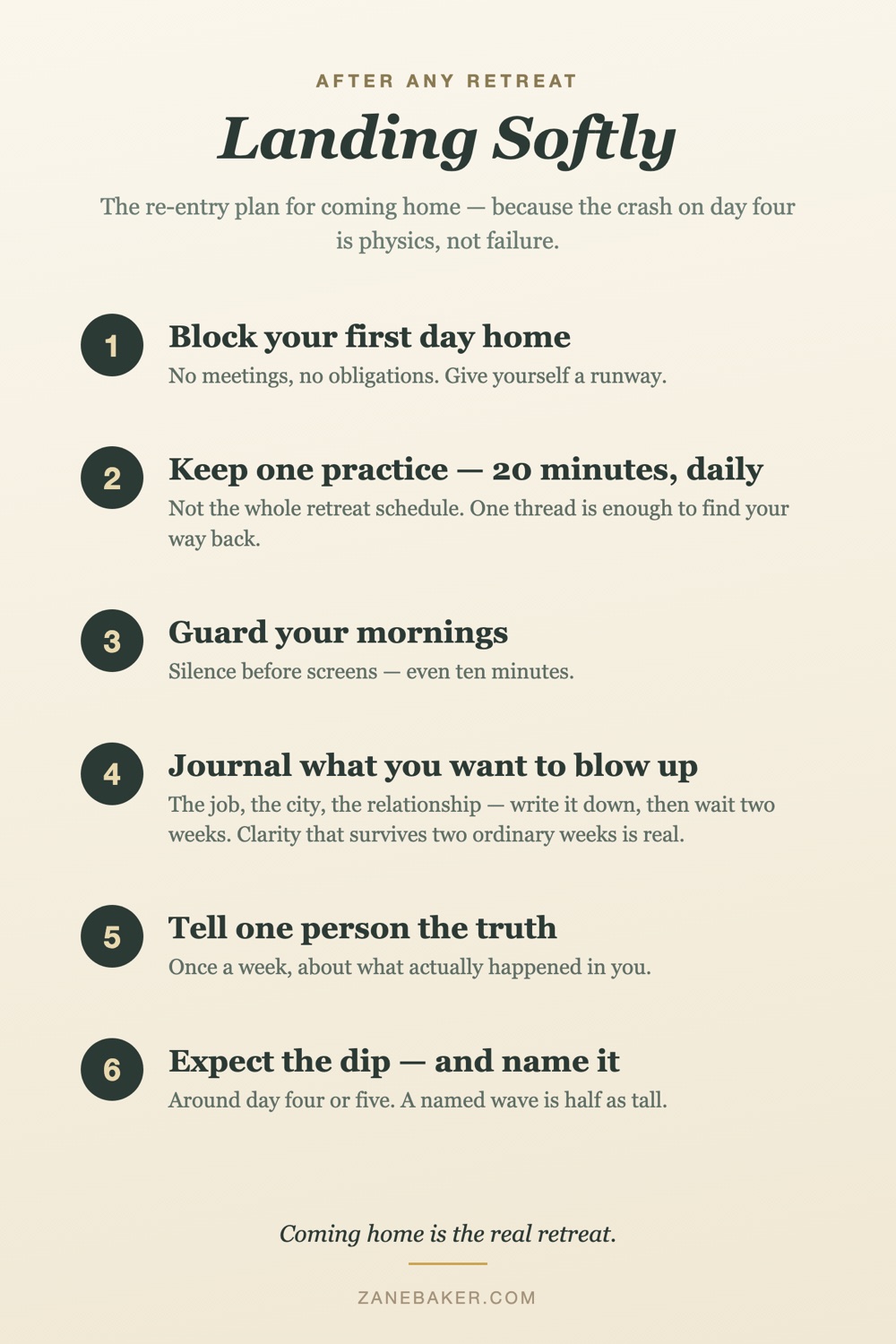
So here’s the plan I gave our guests. We called it landing softly.
- Block your first day home. No meetings, no obligations. That’s the first act of landing softly: give yourself a runway.
- Keep one practice, daily, twenty minutes. Not the whole retreat schedule — one thread. A thread is enough to find your way back.
- Guard your mornings. Silence before screens, even ten minutes.
- Journal — and start with what you’re tempted to blow up. The job, the relationship, the city: write it all down, then wait two weeks before deciding anything big. Clarity that survives two ordinary weeks is real. The rest was altitude.
- Tell one person the truth about what happened in you, once a week.
- Expect the dip around day four or five — and name it when it comes. A named wave is half as tall.
And when you’re vetting retreats, ask what integration support they provide — and whether there’s some form of ongoing community or container afterward: a circle, a monthly call, a place where the work keeps breathing once you’re home. The great ones follow you home. The funnels forget you at checkout.
Why We Stopped Hosting — and What We Built Instead
In 2020, the world closed every room that held gatherings like ours. We had retreats booked that could never happen. We took real losses, made things right with our guests, and closed that season with our integrity intact — which I’d choose again over any refund policy that protects the host instead of the human.
And here’s the part I’ve never written publicly. When we offered those refunds, some of our guests turned them down. What they told me, in essence: We didn’t pay to get money back. We know what this season is costing you. Go live your life — and if you ever host again, we’re already booked. I have no better evidence of what those rooms built. None.

I won’t pretend it didn’t hurt. But I teach that everything is happening for you, not to you — and eventually I had to take my own medicine. What that season showed us was a design flaw, not in our retreats, but in the model itself: healing that depends on a room can be interrupted. So we built healing that can’t be.
What we built instead
The bowls that closed every retreat evening now live in recorded sound sessions anyone can lie down inside of, anywhere, free. Meditations we once guided at sunrise now play at whatever hour your life needs them. The craft continued too — the same hands and intention that held those rooms now make and charge other things we send into the world. The format changed. The medicine didn’t.
To everyone who ever sat in one of our circles: those retreats were exactly what we promised, and you were part of an era I’ll treasure for the rest of my life. You invested in a season that was real, and it lives on in everything we make now. And who knows — in another season, the circle may form again.
How to Get 80% of the Benefit at Home
Until then — or if a retreat simply isn’t in your budget or your bandwidth — here’s the honest secret of the industry: most of what a retreat does can be built at home. What you’re really paying for is permission and protection — a fence around your attention. You can build the fence yourself. Here’s the one-day protocol:
The one-day home retreat protocol
The night before: phone on airplane mode. Tell your people you’re off-grid until tomorrow evening. Prepare simple food so tomorrow requires no decisions.
Morning: wake without an alarm if you can. Thirty minutes of silence before any screen — this is non-negotiable; the whole day is built on it. Eat slowly.
Mid-morning — sitting practice: twenty to thirty minutes, guided or unguided.
Midday — sound immersion: lie down, close your eyes, and play a long-form singing bowl or sound-bath session for forty-five to sixty minutes. This isn’t just atmosphere: a study published in the Journal of Evidence-Based Complementary & Alternative Medicine followed 62 adults through a single hour of singing-bowl sound meditation and found significant reductions in tension, anger, fatigue, and low mood — with the biggest drops in people who’d never done it before. And here’s the quiet miracle for our purposes: sound does this work through a speaker just fine — the frequencies don’t care whether the bowl is in the room or in the recording. Mine live free on YouTube and Spotify; use mine, or use anyone’s that moves you.
Afternoon: walk outside for at least an hour. No headphones. Let the land do what it did at every retreat I ever ran.
Late afternoon — journal: three prompts. What am I carrying that isn’t mine? What is my body trying to tell me that I keep interrupting? What would I do this year if I trusted myself?
Evening: gentle dinner, no screens, early to bed.
Do that once a month and you’ll keep a current running through your life that most people only touch on vacation — for the cost of a notebook.
FAQ
Are meditation retreats worth it?
Yes — when the container matches your readiness and you can see where the money goes. No — when the retreat is a disguised sales funnel or an intensity contest your nervous system didn’t sign up for.
How much does a meditation retreat cost?
The full spectrum: donation-based silent retreats can cost almost nothing; well-run facilitated retreats typically run $1,500–$3,500 all-inclusive; luxury destination versions climb past $5,000. Price and depth are not the same axis.
Are meditation retreats good for beginners?
Genuinely, yes — if you choose short (2–3 days), small, and gentle. Don’t start with a ten-day silent immersion.
Can you do a meditation retreat at home?
Yes. The protocol above captures most of the benefit. What you lose in group energy you save in airfare — and you can repeat it monthly.
What happens at a meditation retreat?
Sitting practice, teaching, shared meals, movement, nature, and honest circles — plus a predictable emotional arc: day-one excitement, a day-two wall, and the opening on the other side of it.
Are silent retreats okay if you struggle with anxiety?
Sometimes — but intensive silence can be overwhelming for a system already under strain. Start with gentler formats, tell the organizers what you’re working with, and if you’re in treatment, loop in your professional first.
Book the retreat when it’s right. Build the practice either way. And whatever you choose, take this with you: everything — the retreat you attend, the one you skip, even the season that closes a door you loved — is happening for you, not to you.
I’m penning a book about learning that the hard way.
May the rest of your life be the best of your life — and may the best manifest. 🌞










Facebook Comments